
 Update from Anne: Many thanks to Mykyta and all the guest writers who have stepped in to keep this blog going as Ruth and I deal with medical issues. My doctors have started me on a new drug that they say just might put my cancer into remission within a few months, and I already feel stronger. So keep your digits crossed and I’ll be back with my usual posts sometime after Thanksgiving. Thanks to all our readers who keep this blog going!
Turn Your Expertise Into a Lead-Magnet Book (Without Getting Scammed Along the Way)
by Mykyta Chernenko
There is a particular book nonfiction writers keep being told to write. It is short, it is free, and it is not supposed to make money. Its job is to bring a stranger into your world so the book you actually sell has somebody waiting for it.
The advice is sound. The execution is usually terrible, and it fails in ways predictable enough to list, which is lucky, because a list follows.
One distinction decides most of it. A lead-magnet book is not a free sample of your real book. It is a small, complete thing that finishes a job. Get that right and the rest follows. Get it wrong and you have written a forty-page advertisement nobody reaches the end of.
What the Free Book Is Actually For
The job is to earn a second contact with a stranger. That is the whole brief. Someone finishes it, thinks “that helped”, and is willing to hear from you again.
Completion is what buys that willingness, which is why the sampler version fails. Three chapters of your big book plus a sales pitch leaves the reader stranded mid-problem, and a stranded person does not feel grateful. They feel handled. A short book that takes one narrow problem and finishes it makes you, in that reader’s head, the person who fixed something for them.
The other failure is a blog post in a trench coat. If the problem is not finished by the last page, you have spent your one credit and got nothing.
There is a gate in front of all this. If you have nothing for the reader to do next, do not write one at all. Anne has said as much here: free samples only work if you have other products to sell. The lead-magnet book is the clearest case of that rule, not the exception to it. A hand-off to nobody is a book you gave away.
Sometimes a Checklist Beats a Book
Not everything should be a book, and the test is not length. It is what the reader must do with the information.
If the task is a known procedure and your reader only needs to not forget step six, write the checklist. One page. They will actually use it, which is more than most books manage. Padding a checklist to book length so it looks serious produces a book that reads like a padded checklist, and readers spot that by page two.
Write the book when the reader has to make judgment calls. When there is no single right answer, when the order of operations depends on their situation, when they need talking out of the obvious wrong move first. That takes pages, because it takes reasoning, and reasoning does not fit in bullet points.
The format also sets the price of attention. A checklist is downloaded more and read less, while a book is taken by fewer people who have each quietly agreed to spend an hour on the problem. The smaller group is usually the better one.
Pick One Problem, Then Make It Smaller
The instinct is to go broad so more people qualify. It backfires every time.
Broad promises are unprovable. “Grow your small business” cannot be delivered in fifty pages and the reader knows it, so the offer reads as noise. Narrow promises are checkable at a glance, which is the only judgment a stranger will make. Compare “a guide to public speaking” with “what to do in the ninety seconds before you walk on stage”. The second has a reader who recognizes herself instantly, and it is the only kind you will finish.
A test worth using: can you name the person, and the week of their life they are in, when they need this? If you cannot, you have a subject rather than a problem, and subjects do not convert.
One more trap, and it is the sad one, because the book is usually good. Do not write for the deeper problem you can see behind the one they describe. If the reader does not already feel it, they will not take a free book about it. Write for the problem people say out loud.
Free on Amazon, or Behind an Email Form?
Both are defensible, and they buy different things.
Free on the retailers buys reach. Strangers find you while they are already shopping, some leave reviews, and none of it depends on your website working. What you do not get is a name, and you cannot follow up with someone you cannot contact.
The mechanics matter before you build a plan on them. Amazon will not let you price a book at zero. The lowest US list price it allows is $0.99, and only for a file under 3MB on the 35% royalty option; at 10MB and up, the floor is $2.99. The workaround is to publish free somewhere else and wait for Amazon to match, which its own pricing page calls a possibility rather than a promise: “we may also make it available for free”. KDP Select then asks for digital exclusivity: “you cannot distribute your book digitally anywhere else, including on your website, blogs, etc.” A book in Select is not a book you can also email to your own subscribers. Pick one.
Gating it behind a form buys the address instead. Fewer readers, all of them reachable. For nonfiction that is usually the stronger play: the next thing you sell may be a course, a talk or a book that does not exist yet, and none of those can be announced through Amazon.
The tiebreaker is practical: will you actually write to those people? A list you never mail is a spreadsheet with guilt attached. If nothing will go out for eight months, take the reach and let the retailer do the work.
The Back Matter Is Where These Books Die
Authors leave this to the last hour, and it decides whether the rest of the work counts.
Send them to one place. Not your website, your podcast, your newsletter, your consultancy and three social accounts. One. Every extra option lowers the odds of any being taken.
Put the invitation straight after the section that solved their problem, while the reader is most pleased with you, and again at the end. Say plainly what they get and how often. “Occasional notes on X, usually monthly” beats “join my community”, because it is a promise a person can agree to.
Then check the thing works. Test the link from a phone. Send yourself the download. Make sure whatever arrives first says something, because a signup that goes quiet for three weeks has taught the reader you do not follow through.
What You Will Be Sold Along the Way
The moment you start looking into this, you will meet an industry. Done-for-you lead-magnet packages. Funnel courses. Paid giveaway pools that promise thousands of subscribers, and that is exactly what they deliver: thousands of people who collect free things and have never bought a book. That list is worse than none, and it teaches you nothing about your real readers.
You will also be told a machine can write the whole thing this afternoon. I run an AI writing company, so take this in the spirit it is meant: for this book, that is the weakest thing you could do with the tool. A model gives back the average of what has been written about your topic, and the average is what your reader found for free last week and did not trust. The wrong turn you took in 2019, the client story that makes the point land, the reason the standard advice fails for people like your reader: none of that is in the training data, because it is in you.
What you genuinely need is dull. The knowledge you already have. A way to deliver a file. A way to collect an email address. That is the whole toolkit, and none of it justifies a four-figure invoice.
How You Will Know It Worked
Downloads are not the number. They measure your cover and your title, which is worth knowing but not the point.
Working looks like a slow, steady arrival of people who are recognisably yours. A few write back. When you publish something for sale, some of them buy it in the first week without being nagged. That is the whole return, and it accumulates over months, not days.
Give it a season, and read the first fifty replies far more carefully than the next five hundred. They will tell you whether you picked the right problem.
If nobody ever replies and nobody buys, resist the urge to redo the cover. The cover is almost never what is broken. The last page usually is.
What about you, scriveners? Have you given a book away to build a following? Did it send anyone anywhere, or did they take the file and vanish?
by Mykyta Chernenko (@NikitaChernenk9) October 3, 2026
About Mykyta Chernenko
 Mykyta Chernenko is the founder of AIWriteBook, a writing platform, and the author of two technical books, The Rational Software Engineer and Full-Stack Web Development. He is a software engineer and tech co-founder working on applied AI, and he spends most of his time on the unglamorous end of publishing: how books actually get finished, and how they find the people who want them.
BOOK OF THE WEEK
Yes, it’s a book for the techies out there. I know Mykyta’s work is more technical than what we usually offer here, and yes, some of this goes sailing right over my head, but it is great advice!…Anne
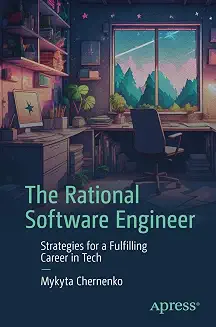
The Rational Software Engineer: Strategies for a Fulfilling Career in Tech (Professional and Applied Computing)
What You Will Learn
- Efficiently organize your work day
- Know when and how to seek a new project, company, or career
- Take care of your body and mind in a software engineering context
- Understand what contributes to job satisfaction and how to integrate it into your career
- Use non-coding activities for your and your company’s benefit
- Build healthy relationships with managers and colleagues
***
featured image by Jose Alba photos for Pixabay


Ahoy Mykyta & Anne,
Sounds like really good advice for non-fiction writers (though in that realm I am a clueless git).
CS–We tend to forget about the nonfiction writers, because most of us here write fiction. But nonfiction really is a different product, and needs to be sold in a different way. It’s all about establishing authority and expertise.
Thank you! Fiction has its own version of this, too. A free short story or a bonus chapter does for a novelist what a short guide does for a non-fiction author: one small, finished thing that makes a reader want the next book.
A free short story, especially if it is available nowhere else – is that the equivalent for fiction?
Short stories are hard, especially in a universe with a main story which isn’t finished yet (I’m working on the third and final volume in my mainstream trilogy), and use a short story about one of the characters as a suggestion for readers to try my writing. But it’s already available for free on my books’ site.
I have thought about adding an origin story for each of the other two main characters, and making a book out of the three stories, but haven’t found equivalent shorts for them. It would be like writing a lead magnet for Gone With the Wind, with stories about Scarlett, Ashley, and Rhett – and Margaret Mitchell never did that.
In our different publishing climate, and indie instead of traditional, do you think that would work?
Alicia–I think a lead magnet is much more important for a nonfiction writer, because they need to establish authority, but it can work for fiction too. If we can draw readers into our world with a free short story, we might pull in some new fans. But I know what you mean about the difficulty of writing something short that fits into the universe of your series. I’ve been working on one myself. I was hoping to have a free story by Christmas, but it looks like it won’t be ready until next year.
I actually did write a bonus short story for my first novel at my publicist’s suggestion. She wanted something I could read at events pre-publication. I still sell copies of that story, but it wasn’t intended as a lead magnet. And, yes, it was very difficult writing a bonus chapter that worked as a standalone short story.
Alicia, I think the origin-story collection could work, and indie publishing is exactly where it can. Margaret Mitchell never had a mailing list to feed. Your first story is already free on your site, so a book of all three gives readers something new to sign up for, and the two new stories are the part they can’t get anywhere else. They don’t need to match the first one in length either. One turning point in each character’s life before the trilogy starts is enough.
Thanks, Anne and Mykyta, this is what I need to spur me into action with a book funnel plan that’s been percolating in my head.
Anne, fingers crossed your new med keeps up the good work!
Debbie–Thanks! I hope your book funnel plan works! And if it does, give me some advice. I need to do that too!
Thank you, Debbie! Start with the smallest version of it: one free book, one page that collects emails, and one line at the end of your books that points there. Everything else can wait until that works, and then you’ll have the advice Anne asked for.
I’m so sorry you’ve been sick. I’m glad that you’re going on a med that will put your cancer in remission. I hope it work and that you start feeling better.
Natalie–Many thanks. I think I am feeling a little stronger, and my doctors have great faith in this new treatment.
I like your advice about sending the reader to one place. I’ve also noticed recently some authors are putting this ask at the front of their books, and not at the end. Still pondering on that one. I also would love to hear from folks about how fiction writers can implement a similar strategy content-wise.
Lissa–I thought that was good advice, too. I have fought many battles with newbie indie authors who start multiple websites and blogs, usually one for each book. All they do is scatter their audience and end up losing them all. As far as a reader-magnet book for fiction, it doesn’t hurt. Everybody likes free stuff, and you just might get some new fans of your series.
Thanks, Lissa. The front-of-book placement makes sense for ebooks, because the retailer sample is often all a browsing reader sees. Some authors do both: a short line up front and the full offer at the end. For fiction, the content is usually a prequel novella, a short story about a side character, or a deleted scene, something that only works once readers care about the people in it.
Excellent post, thank you. And Anne, I’m happy to hear you’re headed for remission. Good to see you pop up here. 🧡
Debby–Thanks. So far I haven’t seen much improvement, but it’s early days. I’m trying to stay positive.
Thank you, Debby, I’m glad you found it useful.
Really useful read. The “without getting scammed” approach is right on the money, as many experts rush to publish and ignore the fine print. I would add that clarity about ownership, timelines and tone is as important as price. The best lead-magnet book is one that is truly you and really helps readers.