by Debbie Burke
For years, I spun my wheels writing mysteries
My heroes were interesting, multi-dimensional, flawed yet likable. My novels won contests, engaged two respected agents, made the submission rounds, and… received rave rejections.
Something was missing but I didn’t know what.
Finally, epiphany struck.
If you’re gonna write crime fiction, you need a criminal.
Big duh, right? I must have been absent from mystery writing class that day.
I’d focused so much on the hero that I pretty much ignored the villain.
The villains in my early mysteries were almost afterthoughts, a convenient character to plug in as the WHO in WHOdunnit. I didn’t really consider why they committed crimes, or what they were doing offscreen while the hero was onscreen trying to solve the mystery.
All those years, turns out I’d been following the wrong character around.
In retrospect, it seems so obvious. Yet that big blind spot hampered my progress for a long time. That’s why I want to share the realization with others who also might have been absent from class that day.
***
Stories require conflict. Who provides that conflict? The villain or antagonist.
Let’s clarify those definitions.
Villains are antagonists but antagonists are not necessarily villains.
An antagonist is the person, obstacle, or event that stands in the way of the hero achieving a goal. Antagonists don’t have to be malicious or evil. They simply oppose the hero’s progress.
By contrast, villains intend to harm others. Their acts are illegal, immoral, or otherwise offensive to society.
Let’s go back to who’s driving the story.
The villain provides the inciting incident that starts the story rolling. They kick over the first domino in the long string of complications the hero must face and overcome.
The villain acts; the hero re-acts. The villain plays offense; the hero plays defense.
For at least the first half of the story, the villain is in charge. They are behind the wheel and have a roadmap of where they’re going (their motive, plan, and goal).
The hero is like a kidnapping victim trussed up and locked in the trunk of the car.
They don’t know where they’re being taken or why. They only know they have to free themselves and escape.
Of course, they can’t remain a passive victim for too long or the reader gives up on the story.
What about genres besides crime? Antagonists still drive the story.
For instance:
In YA, an athlete is slated to play in the championship game until the coach (antagonist) substitutes her own daughter instead. How can the hero overcome favoritism to earn her rightful place?
In romance, a former lover (antagonist) shows up and causes doubt in a long-term relationship that’s fallen into complacency. Will the interloper lure the bored partner away and destroy the relationship?
In mainstream fiction, a woman who’s been her father’s faithful caregiver is shocked when her estranged sister (antagonist) decides she should take over dad’s care. Who will win that family power struggle?
None of these antagonists is malicious or evil (unless that sister is greedy and wants dad’s estate. Can you tell I’m a crime writer?)
Although the hero doesn’t get thrown in a car trunk, the antagonist has nevertheless disrupted their life.
For a good portion of the story, an antagonist or villain is in control of the plot. The hero is so busy reacting to blows (physical, psychological, or spiritual) from the antagonist/villain that they can’t take over the steering wheel.
Then a shift in control happens.
In Syd Field’s classic three-act story structure, this change occurs during Act 2. The hero is hit with a crushing blow and now realizes they need a new plan. They must move in a different direction if they want to take charge of their destiny and vanquish the villain.
The smart, wily, and resourceful hero wrestles free from their bonds, escapes from the car trunk, and runs.
Their fresh resolve and change of direction cause the villain to downshift. Now they’re swerving back and forth, trying to run down the escaping hero.
The villain is still in a superior position, but they’re no longer pro-active. Now they’re re-acting to our hero.
The power struggle between them builds in intensity until the climactic showdown in Act 3.
How does the author deal with a known villain vs. an unknown one?
When the villain is known to the reader, the author can go inside their POV and reveal their motives, plans, goals, and fears. The reader often knows how and when the villain plans to ambush the hero. That foreknowledge makes the reader worry and wish they could warn the hero. Don’t turn left! The villain is around the corner!
Traditional whodunnit mysteries feature an unknown villain. The author must keep their identity a secret until the climax. They are still driving the plot but doing it from behind the scenes, out of the reader’s sight.
That’s where I got in trouble with my early mysteries. The villain was out of my sight too! Complications happened but they often felt random, without enough thought as to why they occurred. How did I overcome that problem?
Look at the story through the villain’s eyes. What do they want? Why do they want it? How far will they go to attain it?
Once you understand the reasons behind the villain’s attacks on the hero, you can create complications that make sense, reveal deeper meaning, and keep the reader wondering what happens next.
The antagonist or villain begins the story in a superior position. They drive plot action that causes trouble for the protagonist.
When the protagonist finally says, “Enough. I’m taking control,” they transform themselves into the hero. And that’s when readers cheer!
by Debbie Burke (@Burke_Writer ) September 6, 2026
***
What about you, scriveners? Did you realize the villain is the engine who drives your plot? Do you have trouble creating powerful villains?
About Debbie Burke
 Debbie Burke writes the Tawny Lindholm Thriller series where spectacular Montana locations provide great crime scenes. She’s also a freelance editor, writing instructor, journalist, and long-time blogger at The Kill Zone, an award-winning site about crime fiction.
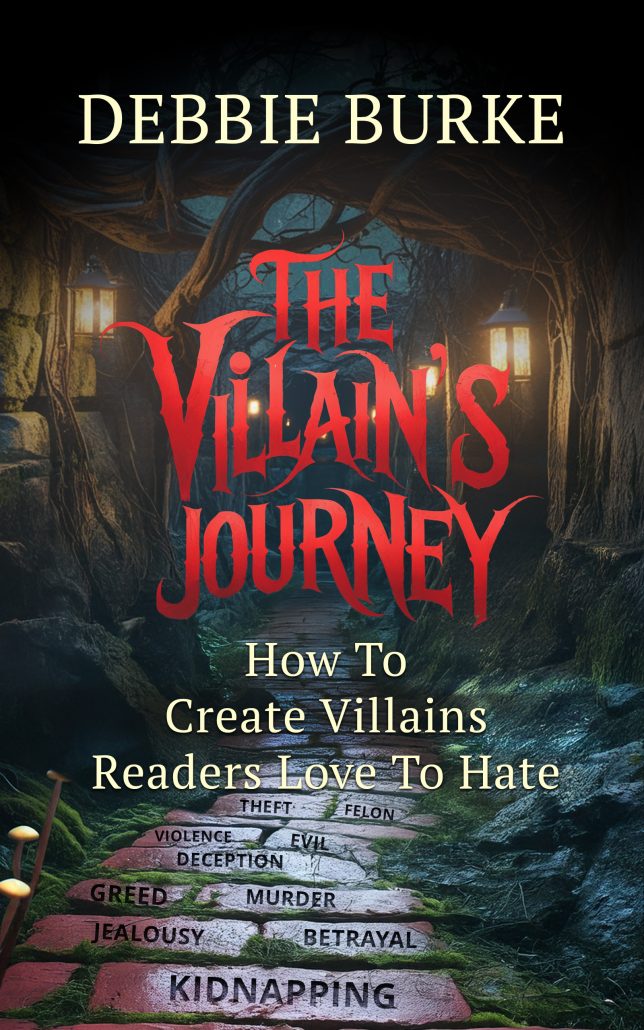
Her newest book The Villain’s Journey-How to Create Villains Readers Love to Hate was a Silver Falchion finalist for best nonfiction and is endorsed by respected writing gurus Christopher Vogler and James Scott Bell.
A reader recently crowned Debbie “the Villain Queen.” She’s not sure yet if that’s an honor or an accusation.
BOOK OF THE WEEK
You’ve read about the Hero’s Journey but what about The Villain’s Journey?
Do you want to write mysteries and thrillers that keep readers up nights? The secret lies inside the Villain.
Discover Debbie Burke’s new craft-of-writing guidebook that takes you on that exciting journey.
The Villain’s Journey is for sale at Amazon, Barnes & Noble, Apple, Kobo, and Bookshop.org


Thanks, Debbie and Anne. I especially liked the comparison to dominos.
Thanks, Kathy! A plot is a chain reaction of falling dominoes.
Great article, Debbie. You explained it so well.
I was taught at a writing workshop that “the antagonist has the plot” precisely for everything you said.
Indeed, a good protagonist deserves an imposing villain.
Hector, I appreciate your kind words.
The more daunting the villain, the more heroic the hero needs to be.
Hi Debbie & Anne,
Great stiff to keep in mind. I really appreciate this post. I think your point is particularly clear when the antagonist is society or the environment, & is particularly intriguing when the antagonist is an element within the protagonist.
CS, excellent point! When the hero shares some traits with the antagonist, the protagonist is not only fighting a foe but themselves. That makes for great conflict. Thanks for that observation.
OooooH Fascinating notion: the antagonist is an element within the protagonist. I guess I have that in a few of those in my screenplays. Ghostly possessions are great examples of that…though I suppose the one trying to free someone of the entity is the protagonist…I’ll have to think on this. Thanks, Debbie for a great post!
I write mainstream literary fiction. My villain is the reason the protagonist re-commits to life, and finds a way to thwart the clever machinations that would affect several little lives.
In fact, the whole of Pride’s Children wouldn’t exist without the villain’s actions, so ultimately, the villain is her own worst enemy.
If she hadn’t intervened the way she did, there would be no happy ending to the story.
Seems appropriate punishment.
Alicia, as you say, villains are often their own worst enemy. I also like stories where the bad guys get their just deserts.
Debbie, your book is terrific and I hope it gets a big readership!!! Your other books are also amazing! Bravo sister friend!
Aw, you’re so sweet, Karen! My work is always improved by your smart, savvy edits.
The idea of plotting a mystery from the villain’s perspective is a useful shift in thinking. If the writer understands what the villain is doing offscreen, the clues and complications can feel much more purposeful rather than appearing simply when the plot needs them.
Exactly, Rackmanadelaide! After finishing the story, the reader can go back, recognize clues, and say, “Aha! That’s why!”