
by Liz Adams
You know how you meet a gorgeous person and you want to ask the important questions right away but feel it’s not proper?
Questions like:
- How many kids do you want?
- Are you allergic to cats?
- Will you promise to always be truthful except when I ask you if I look fat in my jeans?
Such questions would reveal certain sides of us we wouldn’t want them to know right away, so at first, we keep our goals, desires, and beliefs a secret.
Ah, but secrets are the aphrodisiac of reading. Fortunately, there are many ways to drip secrets into your story, and when they are accompanied by a deadline, the results can be riveting.
The Protagonist’s Secret From A Character
Imagine a woman named Cassandra, a woman who loves all things peanutty, with her childhood friend Brad “Smells Like Yum” Johnson, and she’s thinking, “If I told you my secret—I love you—would you never speak to me again?”
Never speaking to him again would hurt.
Or worse, what if he says he loves her, too? That could upend her whole lifestyle and introduce a swamp of complications she’d have to wade through. Imagine all the changes. Renovating her place to look more gender neutral, potential evil in-laws, sharing chocolate bars, it’s like the end of days all over again.
Now imagine if Cassandra’s girlfriend said, “If you don’t tell him that you love him by the end of the day, I’m going to tell him.”
What would Brad, now a brave police officer, think if she wasn’t brave enough to tell him herself? Would he think her a coward?
What would she say to her husband, Brad’s brother, Tom “Leg-Breaker” Johnson?
This deadline has added an urgency to the story. Yay!
A Character’s Secret from the Protagonist
If you’re writing in deep POV, purely from the protagonist’s perspective, it may seem like a challenge to convey secrets kept from the protagonist, but if you didn’t like challenges, you’d skip writing and make a career out of cooking TV dinners. The kind that has gross apple sauce as a dessert.
If, in your story, you sometimes write omniscient or in the point of view of the antagonist, you can make this kind of secret work.
Imagine the female antagonist eyeing our dear Cassandra, stalking her. We don’t know what she looks like, but she puffs on expensive Turkish cigarettes.
In a chapter from Cassandra’s perspective, she meets a kind woman, describes her adorable features, and we delight in seeing Cassandra speak to this stranger candidly, stating her feelings for Brad and all the complications that go with it. We enjoy reading the sisterly dialogue. Until the stranger drops a pack of her expensive Turkish cigarettes. Cassandra doesn’t know she’s in the stranger-danger zone, but we readers do, and we can’t wait to find out what happens next.
A Character’s Secret from the Reader
A character’s odd behavior can be the result of secrets the reader isn’t privy to yet.
In the opening scene, Cassandra checks that the air filters are working, the sealant in the edges of the window panes are unbroken, and she plugs her nose with a heavy-duty nose plugger before going outside. She picks up a stone from the sidewalk and leaves it on the ledge of the neighbor’s outside window.
What the heck’s going on?
We later discover at a morgue that she’s got an over-sensitive sense of smell and, as such, helps the coroner determine the deceased’s stomach contents by smelling them. That sense of smell aspect of her is what caused her husband Tom “Leg-Breaker” Johnson to have trouble putting up with her talent and live elsewhere.
In a later conversation, we learn that the neighbor who doesn’t like to awaken until noon feeds Cassandra’s fish in the evening, knowing to do so if he sees a rock on his window ledge.
If the rock is accidentally knocked off the neighbor’s ledge, there becomes a deadline for Cassandra to return and feed the fish, an example of…
A Secret Only the Reader Knows
The reader knows that because the rock has fallen off the ledge, the fish won’t be fed, but Cassandra doesn’t know that. Granted, if Cassandra goes about her day without any concern for her fish, the reader can get frustrated over no longer sharing the same feelings or concerns as Cassandra.
However, if you have Cassandra suspect more and more that her fish are in danger, the reader can remain connected to her. Perhaps she has a door detector that monitors when her door opens. That way she can be sure the neighbor has entered and gone to feed the fish.
As hour after hour passes with no sign of the door opening, meaning no sign of the neighbor feeding her fish, she might start to worry.
And when the landlord uses a copy of the key to sneak into her room for nefarious reasons, she would see the door opened and text her neighbor, “Thanks for feeding.” Leading to a response of “I didn’t. You didn’t leave a rock.”
She rushes to get home and discovers her fish are starving, her jewelry has been stolen, her cash savings have been snatched, and not a single bar of chocolate in sight.
A Secret the Protagonist and the Reader Don’t Know
In most mysteries, the protagonist and reader don’t know who the villain is and the book is the journey to discover the secret of the villain’s identity together.
When Cassandra is kidnapped by a masked man—and not the heroic Zorro type—she finds herself waking up in her house, seated in her kitchen chair, her husband holding a knife to her throat, and what apparently was her husband’s mistress smoking a Turkish cigarette, puffing a cloud of stench into her face. They plan to kill her and run off together, along with her life insurance payout. The smoke isn’t all she smells. She smells the peanut butter cups on the kitchen table. She grabs one and mashes it into his mouth. He chokes. It’s not a good look on him. Cassandra fights the mistress. Officer Brad rushes in and, seeing the danger, handcuffs his brother Tom.
By using a variety of secrets in your writing, you can make your story a true page-turner.
Reveal All Secrets
There’s still the issue of the protagonist keeping a secret from a character. All secrets need to be revealed. So the next day, when Cassandra decides relationships require sacrifices, and decides that love is more important than chocolate, she offers a square of chocolate to Brad.
He says, “Keep it. I don’t like the taste of chocolate.”
Match made in Heaven.
by Liz Adams (@lizadamsauthor) May 3, 2026
What about you, scriveners? Do your characters have secrets that keep the reader turning the pages? How long do you keep your characters (and your readers) guessing?
About Liz Adams
 Award-winning author of best-selling spicy, paranormal fairytales, Liz Adams tires her hands at the keyboard spinning steamy, surrealistic fantasies so that her readers can also tire out their hands until the happy endings. Playing loud music while reading might hide your squeals of delight. Just sayin’. She lives in the San Francisco Bay Area, and in her spare time, she enjoys movies on the couch cuddling with her spouse and two cats. WARNING: Do not read her books. There’s way too much sex. 🙂
Book(s) of the Week
Thesaurus for Romance Writers (3 books)
Must-Have Resources for Every Romance Writer
Whether you’re crafting a steamy Regency romance or a contemporary love story, Thesaurus for Romance Writers is an invaluable resource that will help you find the perfect words to set hearts racing and pulses pounding in your spicy scenes with captivating synonyms.

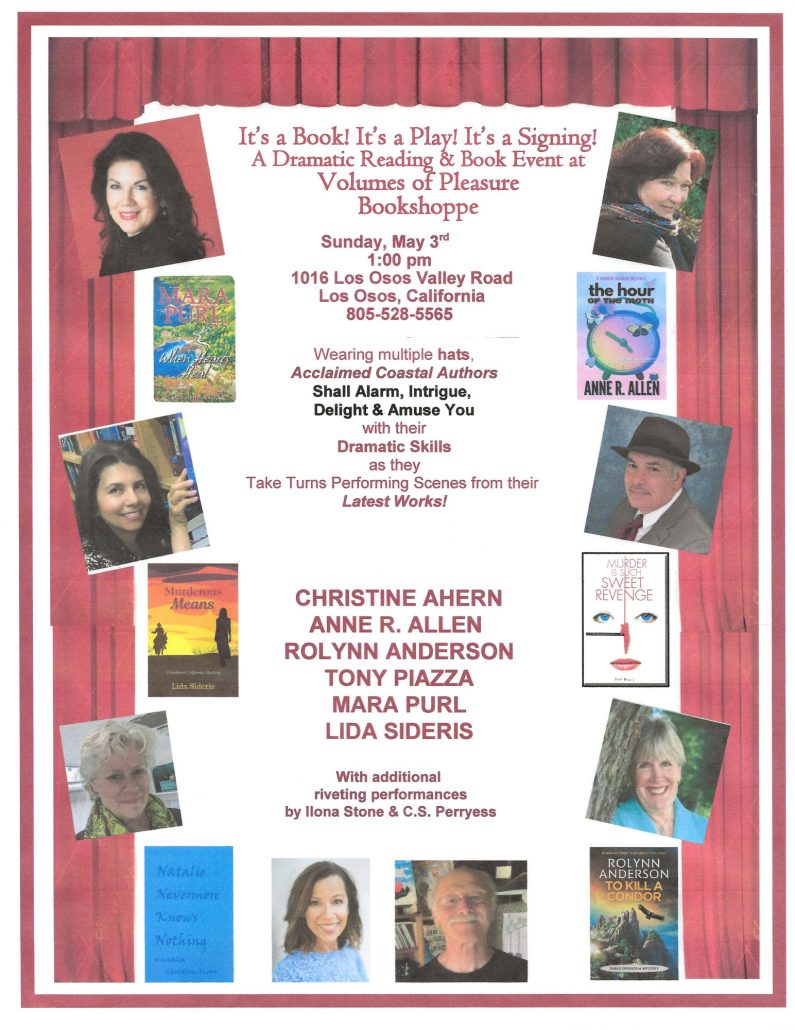
Anne’s Event is Today, May 3!
This is always fun. A group of professional actors and authors present dramatic readings from our latest books
If you happen to be on the Central Coast of California, drop on by the Volumes of Pleasure bookstore in Los Osos. The entertainment starts at 1 PM
There will be food!
***
Free image courtesy of Magnific


I love this blog!
Liz–Thanks for writing this fun post for us!
My pleasure!
love me some good character secrets! great points, Liz!
Thank you, Beth!