by Anne R. Allen
I was talking with a group of book-loving friends recently, several of whom work in bookstores, and they all lamented the “head-hopping” that has become common in adult bestsellers in the last few years.
I agree that head-hopping seems to be everywhere these days. The last several novels I’ve read have all attempted a more or less “omniscient” point of view. Some had a POV that was genuinely omniscient, but others simply hopped into the POV of every character in the story with wild abandon.
The head-hopping only confused me. I constantly had to turn back to figure out who was thinking or talking in this particular scene. Or paragraph. Or sentence. One book lost me completely. I had totally lost track of who the protagonist was, and I didn’t care about any of the characters.
I have no idea why so many books with head-hopping are getting published right now, or why some are so popular. A couple of people suggested that Big 5 books may simply not be edited by humans anymore. This is possible, I suppose.
But one of the most popular books of the year has been The Correspondent, a debut novel by Virginia Evans that has sold over two million copies and is still going strong. It not only presents a single character’s point of view, but that POV is expressed entirely in snail-mail letters. It’s an old-fashioned “epistolary” novel. Not a hint of head-hopping.
I wonder if its fans found it refreshing, as I did, to be immersed in one point of view for a whole novel, so we could really get to know — and care about — the protagonist.
Omniscient POV vs. Head-Hopping
I think the hardest concept to get across to new writers is point of view. Almost every new writer wants to describe the thoughts of every character in the story — “hopping” from one head to another.
This is why head-hopping used to be considered the mark of an amateur. It generally indicates the writer hasn’t yet learned to show various characters’ thoughts and feelings through action and dialogue instead of telling the reader what each one thinks and feels.
Head-hoppers often think they’re writing in an omniscient point of view. But generally, they aren’t.
In true omniscient point of view, the narrator of the tale is a god-like entity with a voice and attitude different from the protagonist or any other character.
I recently read Swamp Story, a novel by the great humorist Dave Barry. It has a truly omniscient POV— and it works perfectly. That’s because you can hear Dave Barry’s humorous voice in every sentence. The omniscient POV reads like a stand-up comic telling you a story.
Omniscient point of view is also great for high fantasy, space opera, historical fiction, and other genres where you want to create an old-fashioned tone or sound like a historian. This point of view distances the reader from the characters as if they’re listening to a storyteller spin a tale, not experiencing the action along with the protagonist.
Think of Rudyard Kipling’s Just So Stories, where the narrator addresses the reader directly as “O best beloved.” Or imagine you’re writing the opening of Star Wars. If you can start your tale with, “A long time ago, in a galaxy far, far away…” you’re probably writing in a truly omniscient point of view.
Why Head-Hopping is Problematic
Obviously, with head-hoping appearing all over the bestseller lists right now, I can’t tell new writers not to do it. But I can say that it puts up a big barrier between you and your reader.
Non-omniscient head-hopping makes a book harder to read. It’s tough for the reader to know who the protagonist is and who we’re supposed to care about. Readers often don’t know who is acting or who is talking.
Head-hopping often treats all the characters as if they are protagonists.
Also, head-hopping is less realistic. In real life, we only know the thoughts of one person: ourselves. In order to find out what other people are thinking, we need to hear them, have someone tell us, or read their body language.
That’s why the third person limited is the easiest point of view for readers to enjoy. It’s what feels the most natural. And it’s what a lot of writing teachers suggest a new writer use for a first novel.
What is the Third Person Limited Point of View?
We call this point of view “limited” because it is limited to one character at a time. You can have several points of view in a third person limited novel, but not in the same sentence or paragraph. They are usually divided by chapters or scenes.
This has been the most common point of view in contemporary novels for some time. I recommend it for most beginning novelists. The exception is YA, where first person is very popular. First person gets the reader closest to the protagonist.
There are two types of third person limited: standard third person limited and deep third person limited. The difference between standard and “deep” third person is how intensely the reader experiences the protagonist’s thoughts and feelings. Deep is almost like first person.
Standard 3rd person
“Run faster!” he told himself. He could tell that rhinoceros was getting closer.
Deep 3rd person
Run faster! The sound of rhino hooves thundered in his ears.
A Tip if You’re Having Trouble with Head-Hopping
There’s a simple hack for new writers wrestling with point of view: rewrite your difficult section in first person.
You’ll be amazed at how you can show what other characters are feeling just by your protagonist’s reactions. You’ll probably find you only have to change a few words.
Yes, you can hop from Jessie’s head to Jake’s: “Fidelity is essential in a relationship, Jake believed. He would never cheat on Jessie.” But you can stay in Jessie’s head and get the same message across with first person: “Jake swore to me that he believed fidelity is essential in a relationship. I knew he would never cheat on me.”
I’m not saying you need to keep it in first person. But try writing at least five pages in first person. Then you can turn it back to third person.
Now you can say: “Jake swore to Jessie that he believed fidelity is essential in a relationship. She knew he would never cheat on her.”
See how easy it is? We’re back in third person and we’ve stayed in Jessie’s head the whole time.
And if you find you’re more comfortable writing in first person, it’s fine to stay there. Lots of great novels are written in first person singular.
But note: first person plural should be reserved for experimental books like And Then We Came to the End by Joshua Ferris. It can be something of a slog to read. (Personally, I never did get to the end. 🙂 )
Should You Use Deep Third Person POV or Standard?
This depends on genre, tone, and personal choice. Deep point of view immerses the reader in the character’s world. It increases intensity.
For thrillers, suspense, and horror, it can strengthen the emotional experience. It doesn’t work as well for light romantic comedy or breezy beach reads. Mysteries where the puzzle is more important than the intensity of emotion could be confusing in deep POV.
But I think every writer’s work can improve from practicing writing in deep point of view. And if you tend toward head-hopping, it can often cure you of it.
I Still Recommend Avoiding Head-Hopping
There’s a quote sometimes attributed to Oscar Wilde: “I never edit my own work. Why would I tamper with genius?” Some beginning writers tend to think that way. Or they’ve fought so hard for their word count, they refuse to give up one word.
Not a good idea. We can all learn new things and improve our writing in many ways. Learning to write using different points of view is useful to all of us. And learning to avoid head-hopping will help keep your book out of the “Did Not Finish” pile.
by Anne R. Allen (@annerallen, @annerallen.bsky.social) May 31, 2026
***
What about you, scriveners? Do you have trouble with head-hopping? Did you find point of view baffling when you started writing? What point of view do you prefer as a reader?
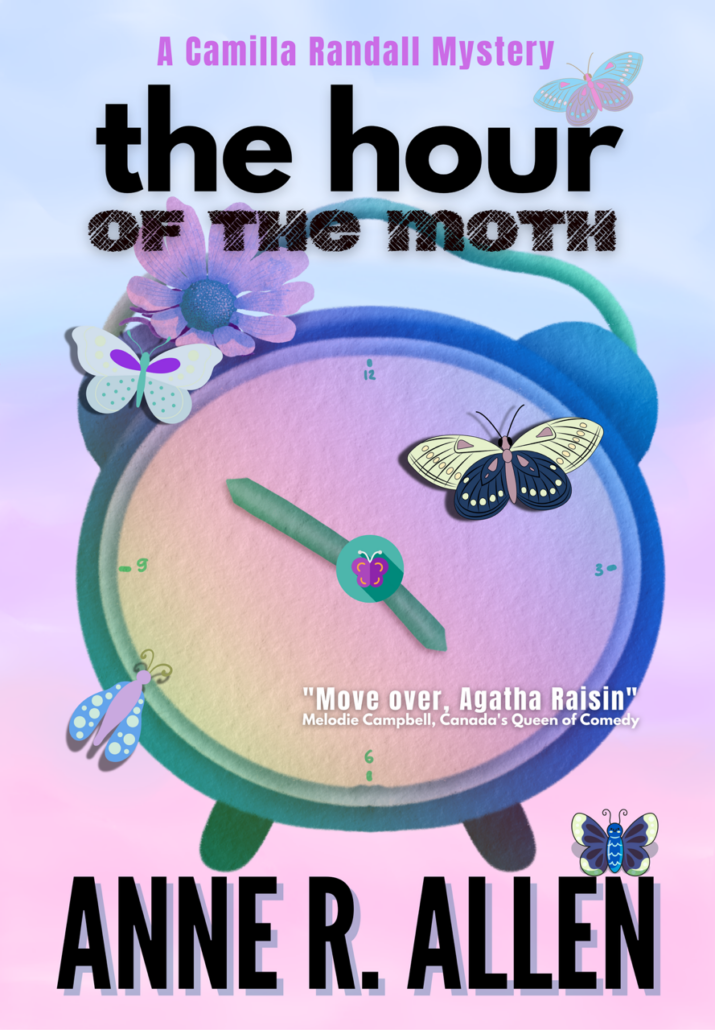
THE HOUR OF THE MOTH
A light and funny beach read where multiple stories are told with only one first person POV.
(And it sure could use some reviews, friends. I was sick during the launch, and didn’t do enough to get ARCs off to reviewers. If you read it and like it, a few words would help a lot.)
Ebook and paper book available at Amazon. Paper book also available at Barnes and Noble
When Camilla Randall allows a neighboring business to hold a “Moth Hour” storytelling event in the courtyard of her beachy California bookstore, she finds an inconvenient corpse left in the audience after the event. The deceased, a storyteller famous for his appearances on NPR, turns out to have a shady past — and a lot of enemies. Unfortunately, Camilla’s boyfriend Ronzo is one of them. But Camilla, with the help of her cat Buckingham, solves the mystery of the murder with clues from each of the storytellers’ tales.
***
Featured image by Samuel Bourke at Unsplash


Important tips and good advice. Some readers enjoy reading thoughts of characters, especially if the thoughts contradict the words (because the character is fibbing, for example). But most readers seem not to want all that inner monologue, especially of multiple characters. Is it about the author’s goal or the reader’s desire? Well, maybe that depends on whether the author also has a goal of attracting readers.
Excellent post!
“Think before you speak. Read before you think.” — Fran Lebowitz
J (he/him 👨🏽 or 🧑🏽 they/them) @JLenniDorner ~ Speculative Fiction & Reference Author and Co-host of the April Blogging #AtoZChallenge international blog hop
Jlenni–It is possible to show that same inner monologue from several characters without head-hopping as long as you put the characters in their own scenes or you use a truly omniscient voice. Head-hopping is when you switch POV characters mid-scene or even mid-sentence. Books like Gone, Girl and The Girl on the Train have several different POV characters, all of whom may be lying, but the inner thoughts are presented in separate chapters. This requires more work on the part of the author, but I think the reader is grateful. At least I am. 🙂
Love the Fran Lebowitz quote. She’s one of my heroes.
Oh Anne- I’ve run so many workshops in point of view, and it always astounds me that aspiring writers simply haven’t thought about it. They are astonished and chagrined to find out there are actually conventions (I won’t say rules). These conventions are for the benefit of readers, as you have said. I also point out that a novel is about a person (singular) with a problem or goal, and obstacles to that goal, which are resolved by the end (one way or another.) The reader expects to be in that ‘person’s’ head for most of the novel, in most cases! Very good post, Anne.
Melodie–As a creative writing teacher, you must have fought this battle daily. New writers often do not want to learn to write for the reader when they have grand ideas of creating “great art”. (Not realizing that all classic literature was created with the reader in mind.) Early in my career, I read an article in WD that said “A novel needs to be about one person.” I was trying to write a “saga” with multiple characters and POVs, that totally wasn’t working, and that showed me why. I took one character out of the saga and gave her her own book. That one got published. 🙂
I’m with you, Anne. I love being in one character’s head & heart, or three or four characters’ heads & hearts when things are divided clearly. I must admit, though, every so often I run into a head-hopping book that works for me. Some authors appear to be able to carry it off some of the time. I’ve no idea what magic they’re accessing, but there you go. Thanks for another fine post.
CS–Obviously some very popular writers get away with head-hopping. Louise Penney is one. I love her storytelling, so I override my annoyance. But the annoyance is still there. 🙂 But you’re right that good storytelling trumps everything else. A good story can survive head-hopping, and that seems to be almost the norm these days.
That was something I was warned very early about in writing life, and I strove quite earnestly not fall into that with my fantasy series. With about 15 main protags, I had to make sure everything/everybody was properly focused. What I ended up doing, was that for each particular chapter, I had at least four scene breaks per chapter so that each character(s) involved in the chapter could expound on their p.o.v. without head hopping. Let me tell you, it weren’t easy to do.
G.B. I agree that dividing POV characters into their own scenes can be a slog for the writer, but I know our readers appreciate it. With fantasy, many authors use a true omniscient POV, and that can work too. But again, the author has to work at it, keeping a distance from the characters and giving the reader the “big picture.” This can also be fun, though, when you can play with “little did she know…” and “in another part of the forest…” tropes.
When I started writing seriously in 2000, first person was the natural style for that novel. It’s still my go-to voice, but I’ve persuaded myself to use third person for some works. Fortunately, I don’t have a tendency to head-hop. It would be interesting to develop a true omniscient narrator, but as you point out, it would have to suit the story.
Audrey–I’m with you. I now write most of my Camilla mystery series in first person. I think it’s most comfortable for the writer, and readers generally are comfortable with it too. It also means you don’t have to worry so much about “deep point of view.” You’re kind of there already, tight in the head of the protagonist, experiencing every scene along with that character. First person writers aren’t going to head hop. We know exactly whose head we’re in all the time. I once tried an omniscient POV novel, and my first query got a phone call from an agent. (Do they even do that anymore?) but all the changes she wanted didn’t work for me. Still, it shows how a powerful narrative voice can attract readers. But as you say, an omniscient voice must suit the genre.
Thank you for this clarifying article. I am in a book club, and we recently read a very popular new work of fiction. There was so much head hopping it affected my ability to just relax and enjoy the read. I pointed it out in our meeting and nobody in the group knew what I was talking about or saw it as a problem. I gave examples and still, no one saw it as a problem. So. . . I guess it no longer is! Except to us writers who have had POV issues drilled into our psyches. I tried to explain omniscient and wish I had this article to refer to. You made it very clear and distinct from head hoping. Thank you!
Christine–Thanks for you input. It’s interesting that nobody in the book group was confused by all the head hopping. Could it be that they were a little confused in spots, but didn’t realize it came from weird point of view shifts? Writers are obviously going to be more aware of the mechanics of a book than non-writers. Of course it may be that they’re simply used to it, as they said.
Hi Anne, I wonder how you would distinguish free indirect discourse (à la Jane Austen) from the other two narrative styles you mention? Personally, FID is one of my favorite styles to read because of the potential for ironic distance to exist side-by-side with a character’s inner thoughts… The layered complexity is so enjoyable when done well! But I can appreciate it’s incredibly challenging to write. I wonder if a lot of the “head-hopping” going around these days is writers trying for FID and just not pulling it off?
Alison–I’m not sure if all these writers are basing their style on the 18th century novel, but probably some are. “FID” is a term invented fairly recently to define the style of writing invented by Fanny Burney, which influenced Jane Austen. It came from the epistolatory novel–one told in letters and diary entries–where each scene is told by a different character in first person in letter form, like Mrs. Burney’s most famous novel, Evelina. In her later novels, Mrs. Burney combined the letter/diary scene with third person narrative, as in her later novel, Camilla This is essentially a switch from third person to omniscient, where the narrator gets into the heads of various characters, then goes back to third person limited. As you say, this is very tough to pull off in a contemporary novel. Some writers may be imitating this, but others may simply be following in the footsteps of 20th century “pulp” novels which were quickly written, and full of head-hopping.
With you on this Anne. I recently finished a book that opened with about eight characters. It felt overwhelming and having to get halfway through the book to learn who is who in the zoo. 🥰
Debby–I’m with you. Too many characters in an opener is too confusing, even if we’re not hopping from one head to another. It’s a problem with mysteries, since we want lots of suspects, but if they’re all jumbled together, we simply don’t care whodunnit. 🙂
Hi Anne. As always, your blog posts never disappoint. Even after my disappearance from blogging for a few years. I agree with you on head hopping. When I wrote my first novel many moons ago, I was guilty of head hopping. Back in the early 2000s, blogging was an essential part of a budding writer’s life. I LEARNED so much for seasoned writers, like yourself. I learned FAST. I’m glad you brought this into context. Because I have noticed so much head hopping in popular works. I find it confusing as well.
I enjoy a true omniscient voice, especially in fantasy! I enjoy first person present in YA. I wrote two YA novels that way and serval short stories. Like all writers, we need to write. We need to keep learning. There is always something new to digest. AND, as in your post, it is good for all of us to have a refresher coarse. THANKS!
Michael–Good to see you here! Yes, I feel as if I’m one of the last writing craft bloggers still standing. So many have gone on to other things. I don’t know how long I’ll be able to keep it up, but I try.
As far as newbie writers head-hopping. I think most of us did. I sure hopped up a storm. I remember when I finally got the courage to show my completed first draft to my English professor mother, she stopped in Chapter one and said “But what’s your point of view?” I had no idea what she was talking about. That’s why first person can be the best bet for a newbie writer. First person present is a little harder to pull off, but it’s still very popular in Kid Lit. It gives an immediacy that keeps them turning the pages.
Deep third, three main characters, and by the end of the first chapter of the first book in my mainstream trilogy, Pride’s Children, the reader has experienced all three pov characters. And is oriented to the style – each scene is from the pov of one of the main characters (and has that character’s name, and a quick heading with date, time, and place if necessary), whichever of them is needed to tell the next part of the story.
I believe in making it easy for the reader!
I’m the one supposed to do the work, and it takes me a while to do these, but part of the written ‘process’ is for me to channel the character, to become them, ‘right behind the eyeballs’, so it is close to your suggestion to write in first person for that character.
Tell readers how you’re going to tell the story – as quickly as possible so the confusion is minimal for the rest of the story (the finished PC will be as long as GWTW) – and stop making them work at it, so they can become the characters instead.
I can’t even imagine reading the head-hopping novels you’re mentioning! I think I’d notice that I was unable to make that identification with the character that makes it possible to live for a while as them.